
VeraSnap Becomes World's First Consumer App to Detect Photo-of-Screen Attacks Using LiDAR Depth Analysis

Logo of the VeritasChain Standards Organization (VSO), a neutral standards body developing cryptographic audit and provenance frameworks for AI systems.
LiDAR

Lidar comparison
VeritasChain releases CPP with LiDAR/ToF depth analysis. VeraSnap delivers world's first consumer LiDAR-based screen detection.
VeritasChain Standards Organization today released CPP v1.4 (Capture Provenance Profile), introducing the Depth Analysis Extension for screen detection capabilities in cryptographic evidence capture workflows.
The specification update is accompanied by VeraSnap v1.3, the reference implementation demonstrating practical application of depth-based screen detection on iOS devices equipped with LiDAR sensors.
■ Independent Research Validation
Five independent research institutions have validated VeraSnap's "world first" claim for LiDAR-based screen detection technology. The comprehensive analysis confirms VeraSnap as the first consumer smartphone application combining dedicated LiDAR depth sensing with open-standard cryptographic provenance (CPP v1.4, RFC 3161). Full technical report available at:
https://x.gd/RJ61G
■ What CPP v1.4 Adds
CPP v1.4 introduces an optional DepthAnalysis extension within the SensorData structure. When a depth sensor is available, the extension records:
- Depth statistics (minimum, maximum, mean depth, standard deviation)
- Plane analysis (dominant plane ratio, distance, plane count)
- Screen detection verdict with confidence level
- Indicator scores (flatness, depth uniformity, edge sharpness)
- SHA-256 hash of raw depth data for integrity verification
The extension addresses a specific threat model: someone photographing an image displayed on a monitor, smartphone, or tablet and presenting it as original capture evidence. Depth sensors can detect the uniform, flat depth signature characteristic of screen surfaces.
■ Platform-Independent Design
CPP v1.4 defines SensorType values for multiple depth sensing technologies:
- iOS: LiDAR (iPhone Pro, iPad Pro), TrueDepth (front camera)
- Android: ToF (Time-of-Flight), StructuredLight, Stereo depth
- Unavailable: For devices without depth sensors
This platform-independent design ensures interoperability. Evidence captured on an iPhone with LiDAR can be verified on Android devices, and future Android implementations can produce compatible records.
■ What This Feature Does NOT Claim
The depth analysis extension provides additional verification data, not definitive proof. The specification explicitly documents these limitations:
- Depth analysis indicates likelihood, not certainty
- False positives are possible with printed photographs or flat artwork
- False negatives may occur with screens at unusual angles
- Human review remains recommended for high-stakes verification
- This feature does not determine truth, authenticity, or legal validity
A screen detection confidence of 0.85 means the system estimates an 85% likelihood based on depth characteristics. It does not guarantee the subject is or is not a screen.
■ VeraSnap v1.3 Implementation
VeraSnap v1.3 implements the CPP v1.4 Depth Analysis Extension as a Pro feature on devices with LiDAR sensors (iPhone 12 Pro and later, iPad Pro 2020 and later).
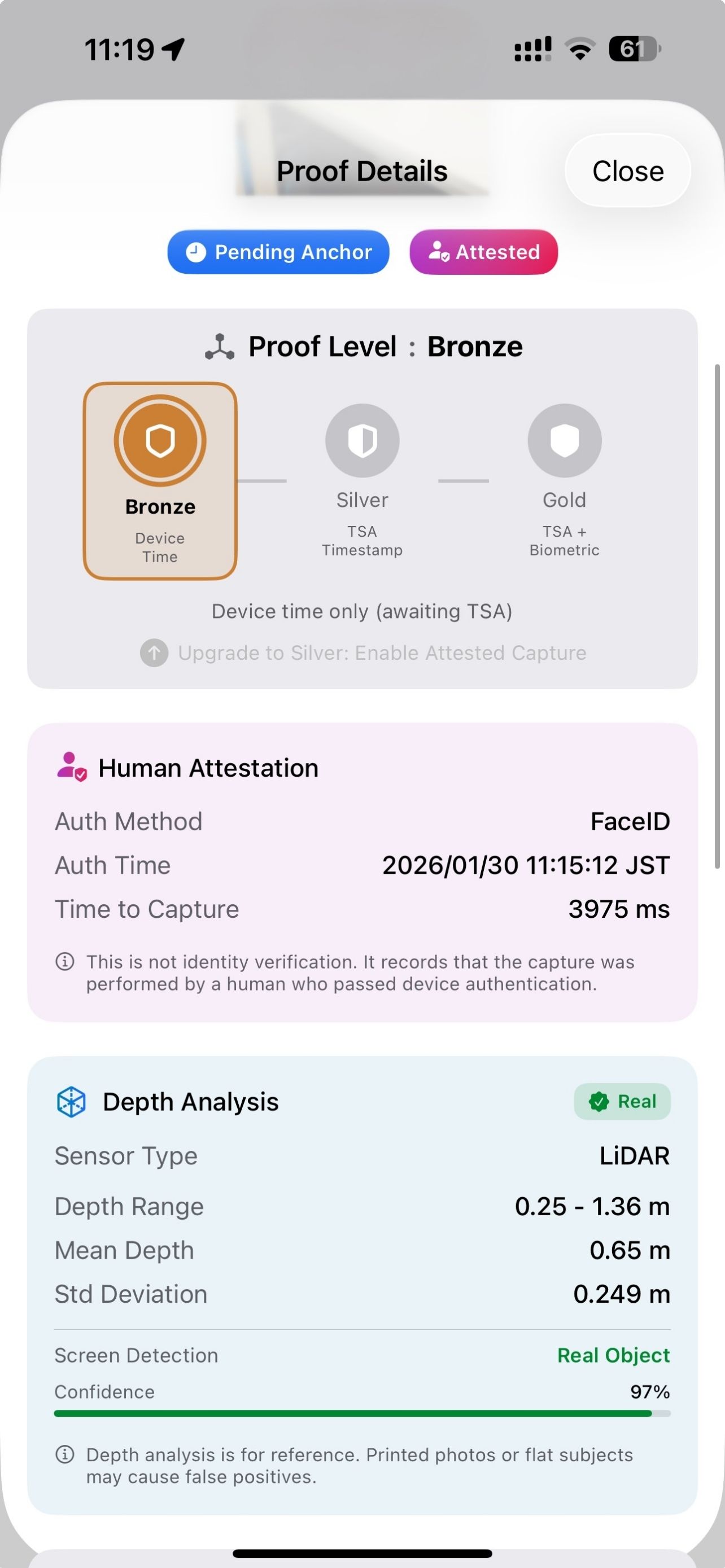
When enabled, VeraSnap captures depth data simultaneously with photo or video capture, analyzes the depth characteristics, and includes the DepthAnalysis record in the cryptographic evidence package.
The verification interface displays:
- Screen detection verdict (Likely Screen / Real Object)
- Confidence level with visual indicator
- Key depth statistics for transparency
Users on devices without LiDAR sensors can continue using all other VeraSnap features. The DepthAnalysis field is marked as unavailable with a reason code.
■ Technical Implementation Notes
Screen detection uses a weighted scoring algorithm based on three primary indicators:
Flatness Score: Screens exhibit minimal depth variation across their surface. Low standard deviation in depth values indicates a flat subject.
Depth Uniformity: Real-world scenes contain objects at varying distances. Screens display a narrow depth range concentrated at a single distance.
Edge Sharpness: Screen boundaries create distinct depth discontinuities. The dominant plane ratio indicates what percentage of the captured area lies on a single flat surface.
The combined score determines the IsLikelyScreen verdict. Confidence reflects the margin from the decision threshold.
■ Privacy Considerations
Depth analysis follows CPP's privacy-by-design principles:
- Raw depth data is not stored or transmitted
- Only statistical summaries and indicators are recorded
- A hash of the original depth data enables integrity verification
- Depth analysis runs entirely on-device
No depth map images or point cloud data leave the device. External parties receive only the computed analysis results.
■ Specification Availability
CPP v1.4 is published under the CC BY 4.0 license, enabling free use, modification, and redistribution with attribution.
The specification is available at:
https://github.com/veritaschain/cpp-spec
The extension is designed as a backward-compatible addition. Existing CPP v1.3 implementations can ignore the DepthAnalysis field without breaking compatibility. Verifiers can process evidence with or without depth data.
■ Implementation Requirements
For implementations adding depth analysis support:
- Depth frame must be captured within 100ms of photo/video capture
- FrameTimestamp must reflect actual depth capture time
- Depth capture failure should set Available=false, not fail the entire event
- Implementations may gate this as a premium feature
■ Intended Use Context
Depth analysis is designed for scenarios where screen-based replay attacks pose a credible threat:
- Insurance claim documentation
- Construction progress photography
- Evidence collection in legal contexts
- Journalistic source verification
- Remote inspection and audit workflows
The feature provides an additional verification layer, not a replacement for existing CPP capabilities including RFC 3161 timestamping, Merkle integrity logging, and optional biometric attestation.
■ IETF INTERNET-DRAFT PUBLICATION
VeritasChain Co., Ltd. announces the publication of the Content Provenance Profile (CPP) Core specification as IETF Internet-Draft draft-vso-cpp-core-00, now available at https://datatracker.ietf.org/doc/draft-vso-cpp-core/
CPP is an open specification for cryptographically verifiable media capture provenance. Unlike approaches relying on device self-attestation, CPP requires timestamps from independent RFC 3161 Time-Stamp Authorities, providing externally verifiable proof of when content was captured.
■ KEY TECHNICAL FEATURES
- External timestamp verification with legal standing under EU eIDAS regulation
- Completeness Invariant for mathematical deletion detection
- Merkle trees with domain separation preventing cryptographic attacks
- Offline verification without network dependency
■ REGULATORY ALIGNMENT
The specification addresses EU AI Act Article 50 requirements for machine-readable content marking (August 2026 deadline) and leverages eIDAS qualified timestamps that enjoy legal presumption of accuracy across all 27 EU member states.
■ RESOURCES
IETF Draft: https://datatracker.ietf.org/doc/draft-vso-cpp-core/
■ Academic Validation
Formal security proof for VeraSnap's deletion detection published on Zenodo (DOI: 10.5281/zenodo.18455556).
https://doi.org/10.5281/zenodo.18455556
VeraSnap implements CPP on iOS with Secure Enclave signing, multi-TSA redundancy, and LiDAR depth analysis. Available in 175 countries with 10-language support.
■ About VeraSnap for Android
Android version will be released soon.
TOKACHI KAMIMURA
VeritasChain Co., Ltd.
kamimura@veritaschain.org
Visit us on social media:
LinkedIn
Bluesky
Facebook
YouTube
X
Other
Legal Disclaimer:
EIN Presswire provides this news content "as is" without warranty of any kind. We do not accept any responsibility or liability for the accuracy, content, images, videos, licenses, completeness, legality, or reliability of the information contained in this article. If you have any complaints or copyright issues related to this article, kindly contact the author above.
